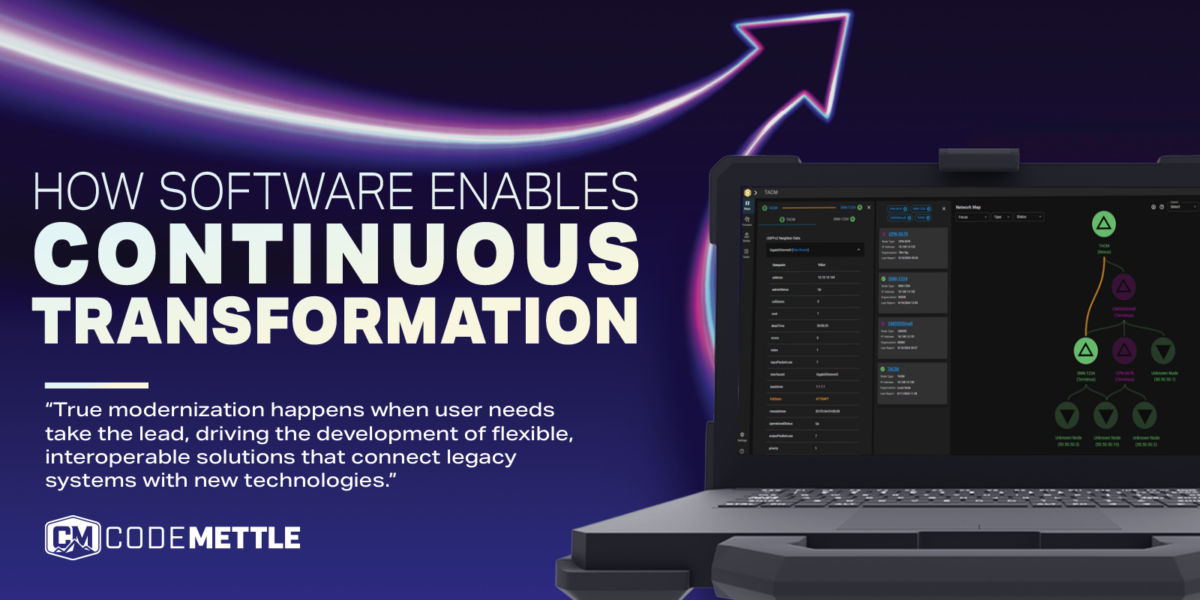
How Software Enables Continuous Transformation 

By Mark Parker, VP of Business Development at CodeMettle

Introduction

Modernization is a continuous cycle challenged by the evolving nature of warfare, the pace of technological change, and complex integration demands. True modernization happens when user needs take the lead, driving the development of flexible, interoperable solutions that connect legacy systems with new technologies. 

Silicon Valley leaders such as Apple, Google, and Tesla have proven that prioritizing user experience and seamless interoperability fuels innovation. The military can benefit from adopting a similar approach that focuses on the user to drive modernization through commercial software strategies, which simplify adoption and increase operational efficiency. 

Why Continuous Transformation? – Current Lessons

Conflict around the world, especially in Ukraine, highlights the urgent need for militaries to adapt to the ever-evolving nature of warfare. Rapid technological innovation often outpaces traditional doctrine and acquisition processes, leaving forces at risk of fighting the last war. To stay ahead of near-peer adversaries, speed and agility are essential. Ukraine’s success has underscored this by demonstrating how effectively leveraging commercial technologies can counter more heavily resourced opponents. Yet, challenges to modernization remain. The rapid pace of technological evolution makes it challenging to keep pace, while user adoption lags due to steep learning curves and training gaps. Fragmented systems and persistent interoperability issues further complicate efforts. In an increasingly software-defined world, relying on outdated hardware-centric approaches to modernization is no longer sufficient. 

Humans live in a constant cycle of transformation, and the Department of Defense (DoD) should be no exception. When you think about the changes in your personal life, most have been driven by software, not hardware. From how we communicate on smartphones to how we consume entertainment or automate daily tasks, software has been the key enabler of progress. These same lessons apply to defense modernization. Just as our personal devices evolve through continuous software updates and integrations, the DoD must embrace a software-first mindset to remain agile, connected, and mission-ready. 

Challenges in Transformation/Modernization

The pace of emerging technology presents both opportunities and challenges for the DoD. As software and hardware solutions evolve rapidly, the risk of obsolescence increases, making it challenging to justify lengthy acquisition cycles and high costs. User adoption is another hurdle, with training and onboarding often struggling to keep pace with the introduction of new capabilities. All the while, competing priorities within programs and services can stall progress. Fragmented solutions only compound the issue, as individual tools lack the cohesion and interoperability of holistic, system-level approaches. To truly modernize, the DoD must align around user requirements and develop integrated, user-friendly solutions that keep up with the speed of innovation. 

Benefits of Having of Having a Software Interface:

  • Shift the workload – Move complexity from hardware to software for greater flexibility. 
  • Affordability – Reduce costs through scalable, upgradable software solutions. 
  • Improved usability – Intuitive interfaces make systems easier to navigate and operate. 
  • Reduced training burden – Simplified workflows accelerate user adoption and readiness. 
  • Software-driven workflows – Enable dynamic updates and rapid integration of capabilities. 
  • Capability insertion – Easily balance backwards compatibility with new features without hardware overhauls. 
  • Automation – Leverage AI/ML to enhance operational efficiency and decision-making. 

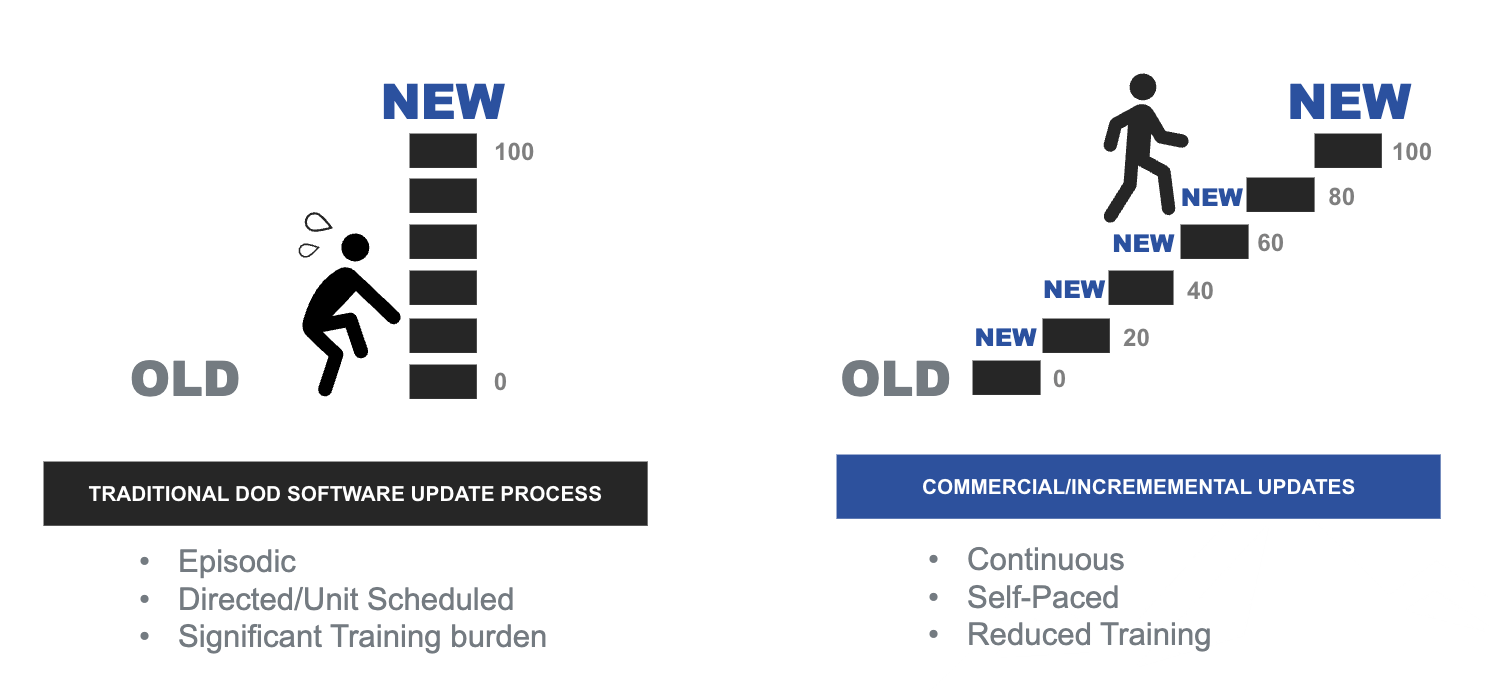
Benefits of Incremental Software Updates:

  • Continuous transformation – Users evolve alongside the software with ongoing improvements. 
  • Flexible adoption – Users can choose when to adopt updates based on their readiness. 
  • Faster adoption – Smaller changes require less training and are easier to integrate. 
  • Dual-track progress – Supports day-to-day operations while enabling long-term transformation. 
  • Iterative improvement – Incorporates feedback quickly and reduces long-term technical debt. 
Conclusion

To meet today’s defense challenges, the DoD must adopt a true software-first mentality, leveraging proven transformation approaches from the commercial world. Leading companies have demonstrated that success begins with user-centric development—putting the end user at the heart of every decision. By embracing this mindset, the military can simplify complex systems, accelerate adoption, and modernize at scale. Instead of relying on rigid, hardware-bound solutions, a vendor- and hardware–agnostic approach empowers flexibility and resilience. Just as importantly, bridging legacy systems with new technologies allows for incremental, low-risk transformation rather than costly overhauls. 

At CodeMettle, we enable this evolution by delivering user-driven, interoperable software that unifies networks and supports continuous modernization without disrupting mission operations. We have led the way in user-driven, software-first solutions for the US Army, where Soldiers rely on us to help modernize the tactical edge with cutting-edge capabilities and unparalleled simplicity.  

For more information about enabling continuous transformation and modernizing your tactical network, contact [email protected].
CodeMettle & MOSA-Conformity: A low-risk, cost-effective approach to enable interoperability and rapid technology insertion  

Conformance to MOSA means embracing business and technical strategies to create systems grounded in modularity and standard, open interfaces to:  

  • Drive cost-effectiveness 
  • Reduce programmatic risk  
  • Promote interoperability 
  • Remove barriers to rapid technology insertion 

While not new, it became U.S. law in 2018 that all major defense acquisition programs adopt MOSA to the maximum extent possible. At this time, CodeMettle had been involved in multiple U.S. Army initiatives, which had implemented MOSA as a requirement. As the Department of Defense (DoD) rolled out the MOSA requirement across all programs in early 2019, we realized embracing MOSA was key to:  

  • Working directly with customers within their construct
  • Providing scalable, innovative solutions to all our customers
  • Our long-term viability and competitiveness in the defense market  

CodeMettle concluded that conforming to MOSA necessitated two fundamental changes in the way we do business and develop software:  

1. Shift from custom solutions to a Commercial-Off-The-Shelf (COTS) product portfolio. Industry expertise dictates that COTS products with defined purposes grounded in open standards enable the benefits of MOSA for both industry and customers, whereas customized solutions are antithetical to them.  

2. Commit ourselves to true Agile and institute DevOps. This led to a period of organization-wide restructuring, during which we let go of the programmatic and technical processes of the past and embraced new methods that enable MOSA and productization. 

We have spent the last five years developing the most advanced NetOps product portfolio that is MOSA-conforming, capable of meeting defense customer requirements, and adaptable from the edge to the enterprise. The forthcoming white paper will explore how our alignment to product development and DevOps and Agile restructuring enable our product portfolio to conform to MOSA.

Download our white paper to learn how CodeMettle leverages MOSA in our business and technical strategies to bring you the most advanced NetOps products.

[wpforms id=”1627″ title=”false”]

April 16th: CodeMettle Exhibiting and Presenting at the 2025 APG Spring Expo

Watch our presentation “How Software Can Enable Continuous Transformation” at 9:15 AM at the APG Tech Expo. The presentations will be located on the second floor of Top of the Bay.

Presentation Abstract:  

Network modernization is a continuous cycle driven by the need to outpace near-peer adversaries. However, it is often complicated by the increasing pace of emerging technologies, the amount of effort it takes to bring users up to speed with new technology, and the addition of individual-component software tools that fail to holistically address entire systems. While the task of modernization can seem daunting, the military can leverage lessons learned from commercial software providers to overcome these challenges and realize the transformative benefits for the future of warfare.  

In this presentation, CodeMettle will explore how it and companies such as Apple and Tesla have found success in bringing about modernization in their respective domains by putting real-world users and a focus on seamless interoperability at the heart of their products. Whether it be Apple’s magic-like interoperability across its portfolio, Tesla’s incremental usability updates, or CodeMettle’s user-centric Network Operations solutions for unifying networks, these examples illuminate valuable insights readily applicable to military modernization efforts. Taken together, these insights reveal that real transformation and modernization occurs when users’ needs drive development. Additionally, we find that when executed properly, commercial software can effectively bridge the gap between new and legacy technologies, simplify the modernization process for users, and significantly enhance the operational efficiency desired in military efforts. 

7 Design Principles That Make CodeMettle the Leader in NetOps Software

Design Matters 

We aim to create software for the most challenging environments and our design philosphy reflects that. It inherently helps us anticipate and solve problems no other software can. Our design philosophy sets up our customers up for success in the most complex networking environments. Our commitment to these seven principles enables us to create user-centric solutions that unify networks, streamline operations, and empower decision-making. 

We understand that the effectiveness of your network operations (NetOps) depends on functional software that empowers you to succeed in the most complex, contested, and critical environments. That is why we prioritize user needs in every step of our software design process and adhere to strict design principles so you can turn complexity into your competitive advantage. 

Here is a closer look at our seven design principles and how we leverage them in product design to deliver unmatched effectiveness and usability for all our users: 

Fast
CodeMettle products and solutions are designed to operate at the speed of your mission, with minimal latency and maximum performance. Your team can go from install to operational in less than three minutes and access critical information to make decisions at the speed of relevance. A reduction of steps also enables users to get their job done quickly.  

Secure
Our solutions are hardened to withstand threats while maintaining usability. We implement industry and Government-approved safeguards from the start, with many of our solutions successfully gaining authority to operate on defense networks. From encryption to role-based access, we help ensure your operations stay safe in any environment. 

Interoperable
Interoperability is key in environments with diverse, disparate systems and technologies. CodeMettle software is open and modular, seamlessly integrating with new and legacy platforms to provide a unified network infrastructure. This ensures that teams and platforms can operate cohesively without being hindered by compatibility issues. 

Lightweight
Bulky software slows NetOps down and isn’t conducive to tactical communications units. We design lightweight yet powerful products that respect network constraints and minimize resource consumption without sacrificing functionality, whether executing commands or processing large data sets.  

Familiar
Military personnel already deal with enough complicated tools and processes, not to mention the time it takes to learn them all. We build user-friendly interfaces and workflows that feel as familiar as everyday technology, like the smartphone in your pocket, which minimizes learning curves and maximizes productivity from day one. 

Scalable 
As operations grow or your needs change, you need the ability to scale your network up or down at will. Size doesn’t matter at CodeMettle. Our solutions are designed to evolve alongside your missions, whether you’re operating a singular terminal locally or adding a new fleet of nodes across the organization.  

Are you ready to learn more about how CodeMettle products can transform complexity into your competitive advantage? Explore our website or contact us for an in-depth demonstration at [email protected].