How Software Enables Continuous Transformation 

By Mark Parker, VP of Business Development at CodeMettle

Introduction

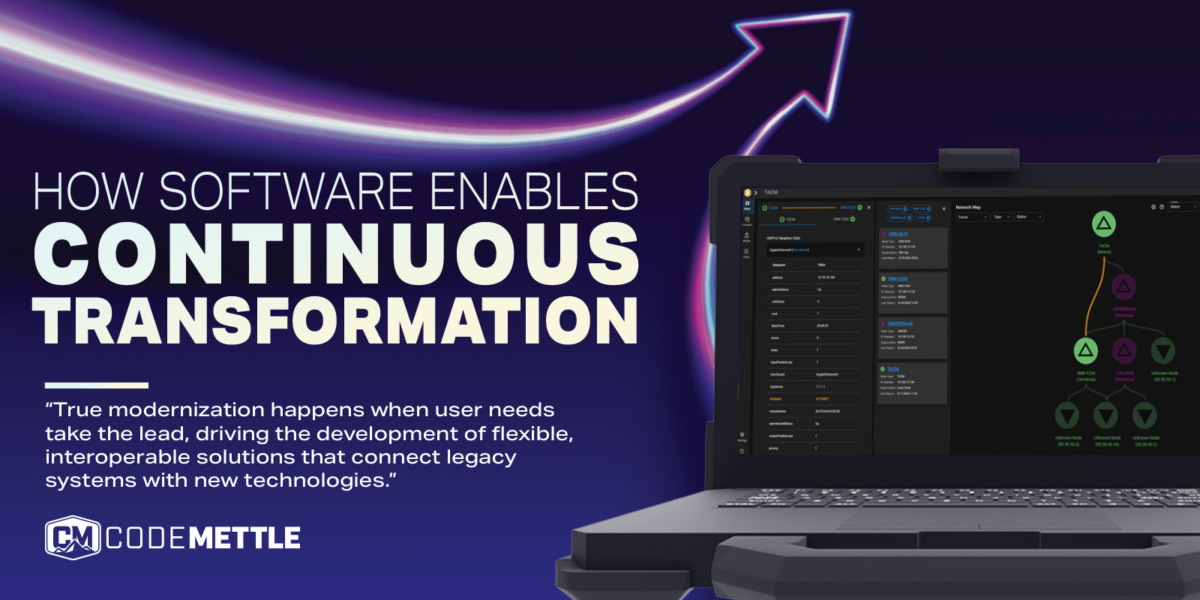
Modernization is a continuous cycle challenged by the evolving nature of warfare, the pace of technological change, and complex integration demands. True modernization happens when user needs take the lead, driving the development of flexible, interoperable solutions that connect legacy systems with new technologies. 

Silicon Valley leaders such as Apple, Google, and Tesla have proven that prioritizing user experience and seamless interoperability fuels innovation. The military can benefit from adopting a similar approach that focuses on the user to drive modernization through commercial software strategies, which simplify adoption and increase operational efficiency. 

Why Continuous Transformation? – Current Lessons

Conflict around the world, especially in Ukraine, highlights the urgent need for militaries to adapt to the ever-evolving nature of warfare. Rapid technological innovation often outpaces traditional doctrine and acquisition processes, leaving forces at risk of fighting the last war. To stay ahead of near-peer adversaries, speed and agility are essential. Ukraine’s success has underscored this by demonstrating how effectively leveraging commercial technologies can counter more heavily resourced opponents. Yet, challenges to modernization remain. The rapid pace of technological evolution makes it challenging to keep pace, while user adoption lags due to steep learning curves and training gaps. Fragmented systems and persistent interoperability issues further complicate efforts. In an increasingly software-defined world, relying on outdated hardware-centric approaches to modernization is no longer sufficient. 

Humans live in a constant cycle of transformation, and the Department of Defense (DoD) should be no exception. When you think about the changes in your personal life, most have been driven by software, not hardware. From how we communicate on smartphones to how we consume entertainment or automate daily tasks, software has been the key enabler of progress. These same lessons apply to defense modernization. Just as our personal devices evolve through continuous software updates and integrations, the DoD must embrace a software-first mindset to remain agile, connected, and mission-ready. 

Challenges in Transformation/Modernization

The pace of emerging technology presents both opportunities and challenges for the DoD. As software and hardware solutions evolve rapidly, the risk of obsolescence increases, making it challenging to justify lengthy acquisition cycles and high costs. User adoption is another hurdle, with training and onboarding often struggling to keep pace with the introduction of new capabilities. All the while, competing priorities within programs and services can stall progress. Fragmented solutions only compound the issue, as individual tools lack the cohesion and interoperability of holistic, system-level approaches. To truly modernize, the DoD must align around user requirements and develop integrated, user-friendly solutions that keep up with the speed of innovation. 

Benefits of Having of Having a Software Interface:

  • Shift the workload – Move complexity from hardware to software for greater flexibility. 
  • Affordability – Reduce costs through scalable, upgradable software solutions. 
  • Improved usability – Intuitive interfaces make systems easier to navigate and operate. 
  • Reduced training burden – Simplified workflows accelerate user adoption and readiness. 
  • Software-driven workflows – Enable dynamic updates and rapid integration of capabilities. 
  • Capability insertion – Easily balance backwards compatibility with new features without hardware overhauls. 
  • Automation – Leverage AI/ML to enhance operational efficiency and decision-making. 

Benefits of Incremental Software Updates:

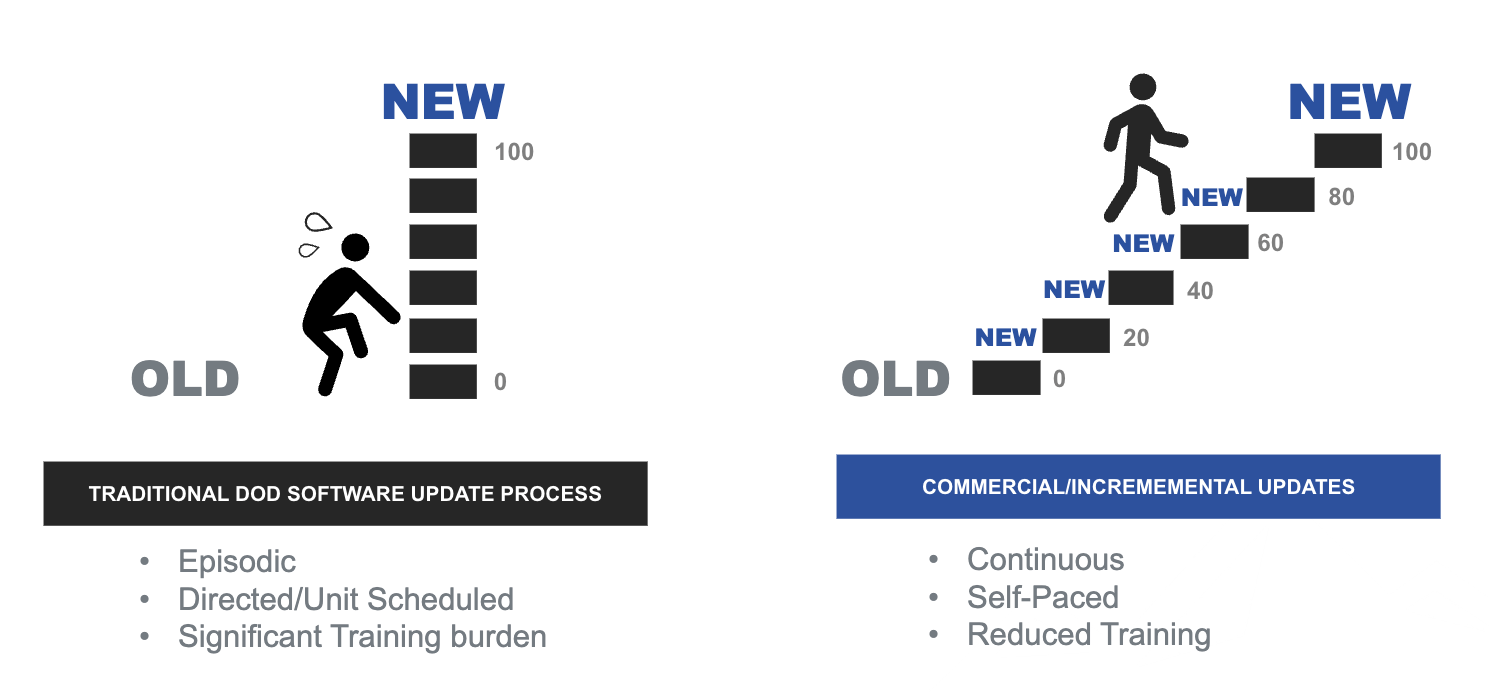
  • Continuous transformation – Users evolve alongside the software with ongoing improvements. 
  • Flexible adoption – Users can choose when to adopt updates based on their readiness. 
  • Faster adoption – Smaller changes require less training and are easier to integrate. 
  • Dual-track progress – Supports day-to-day operations while enabling long-term transformation. 
  • Iterative improvement – Incorporates feedback quickly and reduces long-term technical debt. 
Conclusion

To meet today’s defense challenges, the DoD must adopt a true software-first mentality, leveraging proven transformation approaches from the commercial world. Leading companies have demonstrated that success begins with user-centric development—putting the end user at the heart of every decision. By embracing this mindset, the military can simplify complex systems, accelerate adoption, and modernize at scale. Instead of relying on rigid, hardware-bound solutions, a vendor- and hardware–agnostic approach empowers flexibility and resilience. Just as importantly, bridging legacy systems with new technologies allows for incremental, low-risk transformation rather than costly overhauls. 

At CodeMettle, we enable this evolution by delivering user-driven, interoperable software that unifies networks and supports continuous modernization without disrupting mission operations. We have led the way in user-driven, software-first solutions for the US Army, where Soldiers rely on us to help modernize the tactical edge with cutting-edge capabilities and unparalleled simplicity.  

For more information about enabling continuous transformation and modernizing your tactical network, contact [email protected].
CodeMettle & MOSA-Conformity: A low-risk, cost-effective approach to enable interoperability and rapid technology insertion  

Conformance to MOSA means embracing business and technical strategies to create systems grounded in modularity and standard, open interfaces to:  

  • Drive cost-effectiveness 
  • Reduce programmatic risk  
  • Promote interoperability 
  • Remove barriers to rapid technology insertion 

While not new, it became U.S. law in 2018 that all major defense acquisition programs adopt MOSA to the maximum extent possible. At this time, CodeMettle had been involved in multiple U.S. Army initiatives, which had implemented MOSA as a requirement. As the Department of Defense (DoD) rolled out the MOSA requirement across all programs in early 2019, we realized embracing MOSA was key to:  

  • Working directly with customers within their construct
  • Providing scalable, innovative solutions to all our customers
  • Our long-term viability and competitiveness in the defense market  

CodeMettle concluded that conforming to MOSA necessitated two fundamental changes in the way we do business and develop software:  

1. Shift from custom solutions to a Commercial-Off-The-Shelf (COTS) product portfolio. Industry expertise dictates that COTS products with defined purposes grounded in open standards enable the benefits of MOSA for both industry and customers, whereas customized solutions are antithetical to them.  

2. Commit ourselves to true Agile and institute DevOps. This led to a period of organization-wide restructuring, during which we let go of the programmatic and technical processes of the past and embraced new methods that enable MOSA and productization. 

We have spent the last five years developing the most advanced NetOps product portfolio that is MOSA-conforming, capable of meeting defense customer requirements, and adaptable from the edge to the enterprise. The forthcoming white paper will explore how our alignment to product development and DevOps and Agile restructuring enable our product portfolio to conform to MOSA.

Download our white paper to learn how CodeMettle leverages MOSA in our business and technical strategies to bring you the most advanced NetOps products.

[wpforms id=”1627″ title=”false”]

7 Design Principles That Make CodeMettle the Leader in NetOps Software

Design Matters 

We aim to create software for the most challenging environments and our design philosphy reflects that. It inherently helps us anticipate and solve problems no other software can. Our design philosophy sets up our customers up for success in the most complex networking environments. Our commitment to these seven principles enables us to create user-centric solutions that unify networks, streamline operations, and empower decision-making. 

We understand that the effectiveness of your network operations (NetOps) depends on functional software that empowers you to succeed in the most complex, contested, and critical environments. That is why we prioritize user needs in every step of our software design process and adhere to strict design principles so you can turn complexity into your competitive advantage. 

Here is a closer look at our seven design principles and how we leverage them in product design to deliver unmatched effectiveness and usability for all our users: 

Fast
CodeMettle products and solutions are designed to operate at the speed of your mission, with minimal latency and maximum performance. Your team can go from install to operational in less than three minutes and access critical information to make decisions at the speed of relevance. A reduction of steps also enables users to get their job done quickly.  

Secure
Our solutions are hardened to withstand threats while maintaining usability. We implement industry and Government-approved safeguards from the start, with many of our solutions successfully gaining authority to operate on defense networks. From encryption to role-based access, we help ensure your operations stay safe in any environment. 

Interoperable
Interoperability is key in environments with diverse, disparate systems and technologies. CodeMettle software is open and modular, seamlessly integrating with new and legacy platforms to provide a unified network infrastructure. This ensures that teams and platforms can operate cohesively without being hindered by compatibility issues. 

Lightweight
Bulky software slows NetOps down and isn’t conducive to tactical communications units. We design lightweight yet powerful products that respect network constraints and minimize resource consumption without sacrificing functionality, whether executing commands or processing large data sets.  

Familiar
Military personnel already deal with enough complicated tools and processes, not to mention the time it takes to learn them all. We build user-friendly interfaces and workflows that feel as familiar as everyday technology, like the smartphone in your pocket, which minimizes learning curves and maximizes productivity from day one. 

Scalable 
As operations grow or your needs change, you need the ability to scale your network up or down at will. Size doesn’t matter at CodeMettle. Our solutions are designed to evolve alongside your missions, whether you’re operating a singular terminal locally or adding a new fleet of nodes across the organization.  

Are you ready to learn more about how CodeMettle products can transform complexity into your competitive advantage? Explore our website or contact us for an in-depth demonstration at [email protected].  

CodeMettle Wins $10,000 Grant at MEC Pitch Day

We’re excited to announce that CodeMettle won second place in the Atlanta Metro Export Challenge. This competition highlights and supports Georgia-based companies’ advancement in global markets.

CodeMettle is dedicated to delivering exceptional NetOps software solutions to defense and commercial clients worldwide. As we expand, this award recognizes our progress and serves as a catalyst for an even greater impact on the international stage. 

With this $10,000 prize, we plan to accelerate our internationalization strategy, further tailoring our solutions for non-English-speaking markets and enhancing our global reach. As part of our ongoing partnership with Georgia’s Economic Development teams, we’re strategically positioned to deliver our software to new users across the globe. 

We are grateful to the Metro Atlanta Chamber for hosting this event and allowing us to participate. The support we’ve received is invaluable, and we’re excited to build upon it as we strengthen CodeMettle’s presence in the international market. 

Stay tuned for updates as we continue our international journey, breaking new ground in the global tech landscape. 

Data Driven Network Resiliency Requires Data Fabrics Tailored to DIL Environments 

Data-driven decisions are paramount in every military warfighting function, including Network Operations (NetOps). With the expansion of networks and their reach to the edge, it becomes crucial to empower decision-makers with the necessary data for informed decision-making. However, effectively gathering and utilizing NetOps data in the current network environment presents significant challenges, especially in Disconnected, Intermittent, and Limited (DIL) environments. 

NetOps encounters complex hurdles in demanding operational environments, primarily due to the dispersed, inconsistent, and untimely nature of the available data. The decentralized storage of data across multiple geographically dispersed systems adds to the complexity of accessing and consolidating essential NetOps information for planning, management, and operations. Moreover, outdated or irrelevant data exacerbates these difficulties, resulting in suboptimal decision-making processes and diminished mission success rates. 

Furthermore, the ever-changing battlefield presents further complexities that impede the effectiveness of NetOps. Interference, jamming, cybersecurity threats, and other disruptive elements present significant challenges in maintaining situational awareness, making informed decisions, and achieving mission success. 

This exploration delves into the benefits and challenges of implementing a specialized data fabric for NetOps in DIL environments. A data fabric offers a unified and consistent view of NetOps data across the entire network, streamlining the need for multiple tools and extensive training. A DIL-tailored data fabric strengthens the network, enhances decision-making processes, and ultimately ensures mission success by addressing bandwidth limitations, disruptions, and adverse conditions. 

Data fabrics in DIL environments must account for:  

  • Lazy data transfer: To ensure efficient data transfer in DIL environments, a data fabric should incorporate technical mechanisms such as asynchronous processing, delay management, scheduling, and buffering. These techniques optimize bandwidth usage, allowing for seamless and effective data management.  
  • Local Processing: Local processing enables networked nodes to conduct data analysis and decision-making autonomously. This reduces dependence on external resources and ensures uninterrupted operations, even without network connectivity.  
  • Cloud as Secondary Option: The primary role of the data fabric is to operate effectively in scenarios with limited network connectivity, allowing for local data storage and processing at networked nodes. However, when network connectivity is established, and bandwidth is sufficient, the fabric should seamlessly integrate with cloud resources, enhancing data processing and storage flexibility.  
  • Node Level Independence and Connectivity: Each networked node collects and processes data locally and has data collection mechanisms and processing capabilities. Data synchronization mechanisms enable node collaboration, ensuring data consistency when network connectivity and bandwidth are available. 
  • Bandwidth Control and Prioritization: The data fabric should offer customizable options and mechanisms for managing bandwidth allocation and reservation. By implementing traffic classification and prioritization, data transmissions can be organized based on their significance and urgency. 
  • Data Integration and Transformation: Data integration tools facilitate connectivity and extraction from various sources, while the Extract, Transform, Load (ETL) process automates the extraction, transformation, and loading of data. 
  • Continuous Monitoring and Optimization: Continuously tracking performance indicators, such as network latency and data transfer speed, with advanced tools, ensures optimal functionality. It aids issue detection, informs proactive decision-making, and enhances efficiency, reliability, and cost-effectiveness. Optimization efforts, including configuration adjustments and load balancing, prevent potential disruptions. 
  • Permissions and Trust: A resilient permission and trust framework facilitates decentralized control, data integrity, and security in a data fabric implementation tailored for DIL. This can be accomplished through advanced automation and even enable a zero-trust approach.  
  • Federated Data Fabrics: The implementation of federated data fabrics requires interconnected instances of data fabrics, where each entity independently manages its own instance. This autonomous management ensures seamless integration while maintaining control and autonomy at each level. 
  • Data Governance Framework: To ensure compliance with DoD Accreditation requirements, it is crucial to establish and enforce data policies and access controls. Additionally, it is essential to implement encryption mechanisms that adhere to NIST standards. These measures will effectively safeguard data at rest, during transit, and throughout processing. 

Deploying a tailored data fabric for NetOps in DIL environments brings forth an array of advantages and tackles key hurdles encountered by defense and commercial sectors. As modern warfare and the commercial landscape become more data-centric, the need for effective data management systems becomes crucial to facilitate informed decision-making and operational efficiency. 

Overcoming the challenges of limited bandwidth, intermittent connectivity, and decentralized data storage and management requires harnessing the power of a data fabric. By incorporating technical mechanisms like lazy data transfer, local processing, cloud integration, node-level independence, efficient bandwidth control, data integration and transformation, continuous monitoring and optimization, decentralized control, and robust data governance, the data fabric empowers NetOps operations in any networking environment. With a DIL-tailored data fabric, organizations can effectively address the obstacles posed by the nature of the environment, interference, and decentralized data management, ensuring seamless connectivity and efficient data handling. 

A data fabric offers a unified and consistent perspective of NetOps data, reducing the need for multiple tools and training while boosting situational awareness and data-driven decision-making for organizations. It enables seamless access to distributed data sources, prioritizes critical data transmission, optimizes resource allocation, and ensures effective data integration and transformation. By employing continuous monitoring and optimization, the data fabric enhances performance, reliability, and adherence to governance policies. 

Complete the form below to download the full Data Fabric White Paper.

Simplifying NetOps Within Edge Constraints

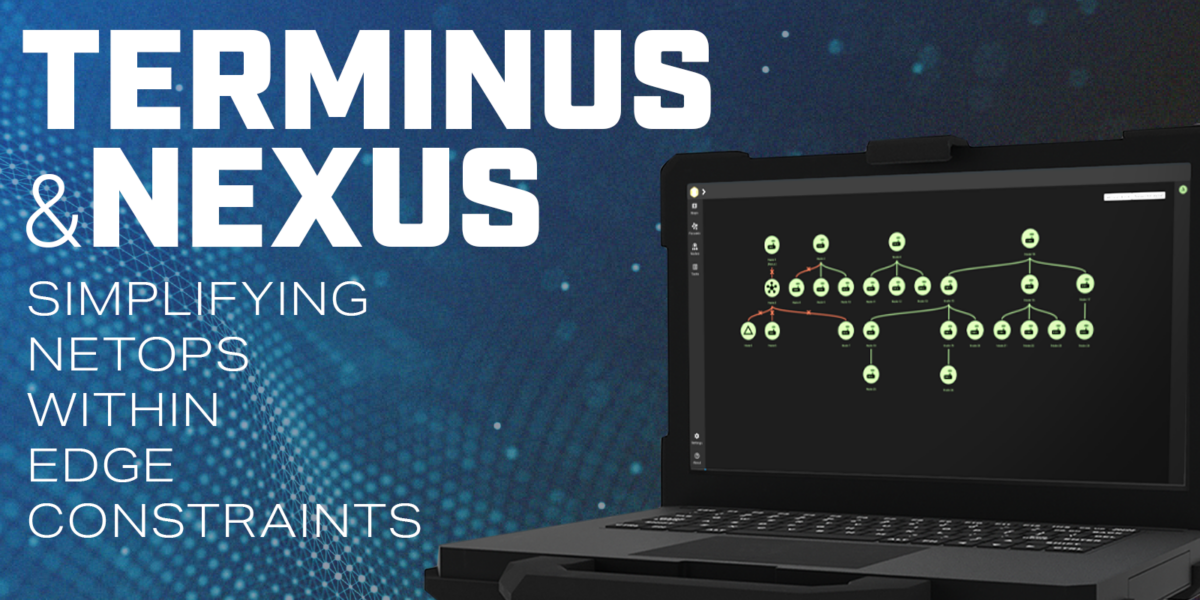
With 15 years of experience working with node operators, CodeMettle has gained a unique understanding of the complexities at the network edge. This expertise has culminated in the development of Terminus and Nexus, our latest Commercial-Off-The-Shelf (COTS) Network Operations (NetOps) software products that are designed specifically for the modern battlefield. Terminus and Nexus abstract the complexity out of the heterogeneous tools, nodes, devices, processes, and networks found at the extreme edge.  

Terminus is a full-featured node manager that is intuitive, simple to use, and comes with hundreds of existing interfaces to commonly managed third-party hardware and software components.  

Nexus provides remote, multi-node management in centralized, decentralized, or hybrid network environments.   

Together, Terminus and Nexus offer the novel ability to interconnect and manage a network of nodes at scale, promoting greater resiliency at the edge.

Additionally, these products:  

  • Promote and enhance collaboration 
  • Offset Disconnected, Intermittent, and Latent (DIL) constraints 
  • Enable easy technology insertion through adherence to open and modular standards 
  • Interoperate with hundreds of third-party hardware and software products out of the box 
  • Offer a consistent, familiar, simple, and intuitive User Interface/User Experience (UI/UX) grounded in real user feedback 

Download the full Terminus & Nexus Overview to learn how your organization can simplify NetOps at the edge.  

[wpforms id=”1357″ title=”false”]

Multi-Path Architecture: A Promise of Resiliency at the Edge

For Warfighters at the edge, the ability to recover in advance of enemy maneuvers is everything. 

Certainly, there have been tremendous strides toward moving information, decision-making and control closer to the edge. Still, one of the biggest sticking points to edge resiliency remains: the inefficient and rigid process to allocate bandwidth to each terminal or device. Until now!

With the sudden viability of low earth orbit (LEO) satellite constellations, the promise of a multi-path architecture creates tremendous possibilities for flexibility and control at the edge. It’s a paradigm shift that could become a game-changer for mission success.

Having many options for transmission is very good for redundancy and multi-path, but it’s only useful if things go bad. Most of the time, all the extra paths will go unutilized and will still cost money and effort to keep up and running. What if we could have the advantages of multi-path for redundancy while also being able to take advantage of multi-path to enable higher bandwidth and new use cases for the network, like plug and play networking? 

Even if we want to take advantage of multi-path, there is a problem of configuring, monitoring, and managing these systems. The more systems you add, the complexity of management rises exponentially. Therefore, there is a need to lean heavily into automation, abstraction and novel user experiences. As the network eventually becomes multi-path everywhere, the ability to add highly trained personnel to manage the network becomes increasingly difficult. There is a need to further simplify and abstract even more than you were expecting in order to push the capabilities and advantages of multi-path to every edge of the network.

Ideally, you want the planners to be able to pick any transmission system available for a mission and then make it so easy to configure that all the operator needs to do is plug everything together, turn the system on and then start providing services to the local area. Long complex setup, configuration and troubleshooting of the network to get the system up and running should be a thing of the past. Highly trained personnel should only be needed at the highest level. The network should be just plug and play, use any network system available, and be operable by anyone with a small amount of training.

The Challenge: Many transmission systems available, but cannot use all of them efficiently

There are a high number of options when it comes to choosing between which transmission systems to use for a particular mission. Yet, for most network configurations, an adequate PACE (Primary, Alternate, Contingency, Emergency) plan is implemented in order to realize high-availability. Most network configurations will struggle to use the available options and bandwidth at the same time.

  • High number of transmission options seems good from reliability point of view, but it it costs time, effort and money to provision, operate, and maintain each piece of equipment
  • Each transmission system employed has its own planning and configuration management process
  • Router configuration complexity grows for each new system added
  • The primary routing choices in government networks (OSPF and BGP) don’t lend themselves to load balancing across links very easily, increasing the expertise required

Even with three to four paths available, most networks can only use one at a time. The PACE plan is used for when one path fails and the other is available to take the load. This is a costly approach since each path needs to be configured to bear the burden of the entire network. 

The Challenge: Many paths across many transmission systems, but certain traffic prefers one over the other

Many paths available for traffic to utilize is nice, but not all transmission systems exhibit the same behavior. Geostationary Equatorial Orbit (GEO) SATCOM with its high-delay and low-bandwidth, or Line of Sight (LOS) microwave with its high-bandwidth and low delay, offer vastly different user experiences. Just ask anyone who has ever made a phone call over LOS, then have the network switch over to SATCOM and they will say the user experience degrades vastly. The long round-trip times associated with GEO SATCOM are very noticeable for real-time traffic like voice, but it’s high reliability and ability to work in regions where LOS may not be possible make it a good choice for many other applications. Having multiple paths for traffic to use is a good thing, but most networks will be configured in a way that all traffic will only use one path at a time as part of a PACE plan.

  • Different applications will prefer and/or tolerate different transmission systems depending on performance characteristics of the application and transmission system
  • Multi-path is nice, but if only one path is used at a time the advantages of each transmission system for different types of applications is lost

Most of the applications will have middling performance most of the time, but will have uneven or unpredictable performance over most networks since the best path for transmission is not chosen on a per application basis.

The Challenge: Antiquated Allocation Process

Today, defense network operators are stuck with outdated network allocation processes and technologies. Here are just three challenges they face: 

  • Planning can take a month. A Satellite/Gateway Access Request, or SAR/GAR, can take from zero to 30 days. So, planners need to generally know what allocation is needed a month in advance.
  • Allocations are meant to be static. If plans change, it’s difficult. While operators have some ability to manage within the spectrum that’s been allocated to their force, they have little ability to dynamically adjust beyond that allocation. Which means, they cannot offer Warfighters desired flexibility in contested environments. 
  • Authorizations for reallocation are managed manually. SAR/GARs are considered one by one. And reallocations are often managed with stand-alone systems set up to track the allocations, terminals and devices. Such manual processes are fraught with delays, errors and access limitations that get in the way of an accurate view of allocation at any one time. 

Additionally, a long-standing defense practice of over-subscribing to GEObandwidth to lock in access and rates creates its own inefficiencies. Oversubscription often leads to load imbalance, with a surplus of bandwidth at some terminals and insufficient bandwidth at others. It’s a costly approach creating unnecessary budget spend, inefficient manpower allocation and decreased network effectiveness.

The concept of multi-path architecture, where defense organizations access LEO, medium arth orbit (MEO), GEO and Wideband Global SATCOM systems (WGS), is not new. Ready access to multiple paths would give network operators flexibility when selecting the appropriate path(s) for email, video and data for each use case. Yet high costs, high risks, elongated allocation processes and limited multi-orbit coverage have been obstacles to achieving the vision of dynamic re-planning of networks.

Then Starlink over Ukraine happened. When SpaceX quickly set up a Starlink internet connection for Ukraine, it was a game-changer earlier in the war. It also shined a spotlight on the viability and effectiveness of LEO, which now has thousands of functional satellites in orbit. Suddenly, LEO constellations were recognized as a (relatively) inexpensive and readily available commercial asset that may make the LEO-MEO-GEO multi-path concept a practical reality.

Unlike with MEO and GEO, there is a low likelihood of interfering with other signals when using LEO. So, there’s less need for situational awareness around how any one LEO constellation is being used – which minimizes the need for painstaking situational awareness and planning. 

This reality brings us one step closer to the promise of a multi-path architecture delivering worldwide coverage, with: 

  • Greater resiliency. With a multi-path architecture, network operators can move from a linear PACE plan to having four viable primary path options. They can maneuver faster and create an asymmetrical advantage against the enemy.
  • New commercial capabilities. LEO is predominantly a commercial endeavor, and a multi-path architecture would instantly leverage the newest capabilities coming out in the commercial space for military applications. The move is aligned with a defense goal of combining the best of COMSATCOM and MILSATCOM for military advantage. 
  • Lower cost. Unlike launching a GEO satellite, which represents years of work and billions of dollars, LEO satellites are far less expensive and launched in the thousands. A multi-path architecture that incorporates LEO will have a lower average cost than one without – and lower than it would have been just five years ago. As LEO satellites continue to launch, the costs should only come down.

Simplifying the Complexity of Multi-Path

Forward-leaning defense leaders are planning now for what’s next. They’re dreaming and thinking and preparing for the day when network operators can do complex satellite networking on the fly in a contested or congested environment. 

One step will be to digitally transform archaic processes used to allocate and manage spectrum, creating a resilient architecture that takes advantage of the new capabilities coming from the multiple LEO-MEO-GEO orbits. That’s where CodeMettle comes in. We have unique DNA in managing transport. We have deep expertise with taking technology built by others and integrating it with a singular interface that simplifies how operators access and use the system of systems. 

Our vision for multi-path is that defense teams maintain full control of which systems they want to use while we create a simple interface that stays the same even when there are different or changing systems on the back end. 

We’re already agnostically managing transport solutions across LEO, MEO and GEO. As multi-path architectures become increasingly viable – and as your operations get more complex with multiple paths – remember that you don’t need to get stuck in today’s processes. Multi-path architecture is becoming viable, creating a paradigm shift that opens up possibilities for greater choice, flexibility, speed and resiliency – from the architecture itself to the user interface. Get ready because we are.

Acceleration, Convergence and Distribution: 3 Key Themes from TEM 9

Earlier this month, we sent a CodeMettle team of three to the network-related Technical Exchange Meeting (TEM) 9 in Nashville, hosted by the U.S. Army’s Network Cross-Functional Team in collaboration with Program Executive Office Command Control Communications-Tactical (PEO-C3T). TEM 9 focused on Capability Sets 25 and 27 in both Pacific and European theaters of operations. 

We’ve been attending TEM events since about TEM 5 and we always look forward to the Army updates, technology breakout sessions and, especially, the informal one-on-one and small-group engagement with Government decision-makers. 

This year did not disappoint. In fact, with numerous high-profile senior leaders in attendance and more than 1,000 participants from war offices around the world, TEM 9 was simply phenomenal! We moved from one discussion to the next exploring the challenges, progress and the art of the possible for defense networks. 

Now that we’re back, we’ve had a moment to reflect on TEM 9 – and to capture three key themes that should have the greatest impact on our collective next steps:

1) Acceleration is Driving Defense Adoption of Commercial Best Practices

Like it or not, innovation is happening within the Army and across all joint and allied forces. For decades, defense forces relied on custom technologies proven to stand up to their rigorous performance and security demands. But technology innovations are continuing at their accelerated pace, with an increasing reliance on software-driven products. 

At the same time, escalation of the Great Power Competition is hastening anticipated conflict ahead of the 2030 target defense teams had been tracking to. Conditions are evolving quickly, and many anticipate a potential conflict within 5 years. The Department of Defense (DoD) can’t keep doing technology the way it used to. 

The Army is pushing itself to adopt and adapt commercial best practices. Part of the push is to shave costs. More importantly, there’s a push to quickly deliver innovative Warfighter solutions – that don’t harm national security – in advance of a potential conflict with peer adversaries. 

“X”-as-a-service solutions, for example, offer tremendous flexibility and help to maintain the fast pace of technology advancement. Adoption of DevSecOps is a meaningful shift that supports defense adoption of software-driven products, allowing for greater acceleration of capability that’s making our Army faster, stronger and more agile. 

These advancements introduce both capabilities and complexities that are new to the Army and its protocols. Which means, the Army and its industry partners must continue to collaborate to quickly implement industry best practices and solutions to give our Warfighters an edge in battle. Industry should be looking for ways to help accelerate that digital transformation.

2) Convergence is Bigger than Network Technology

When the Army says “convergence,” their Project Convergence initiative and demonstrations quickly come to mind. The Army is committed to network modernization that enables multi-domain operations for joint forces at the tactical edge. For some time, the DoD, Army and the other branches – and here at CodeMettle – have been exploring network convergence such as edge-to-enterprise network operations and Unified Network Operations (UNO). Those initiatives and advancements are certainly central to the convergence conversations. 

At TEM 9, though, convergence was about more than the network. Converging the network is important, but the true power of convergence comes from converging many capabilities with the network into a faster, more lethal force. That is, speeding up the delivery and understanding of key data, communications and situational awareness for commanders and Warfighters, to enable a faster kill chain.

There’s tremendous potential and innovation around the convergence of ideas and technologies to meet Warfighter needs. The Army led exploratory discussions that asked, “How do ideas converge at the layer of data? Or at the layer of networking? Or applications or Zero Trust?” 

It’s clear that advancements such as Zero Trust are essential. ZT must be a global, enterprise-wide approach. It can’t be effectively implemented in parts of a technology ecosystem or in some locales. Requirements cannot become a responsibility managed by disparate groups with separate and important mission sets. 

The group agrees that, if software is the answer and hardware is the platform, defense must be software-focused and platform-agnostic. It’s also clear that convergence is a rich vision that requires deep engagement across functions and across defense, industry and academia. 

3) Distribution of Data is Essential

While the convergence of forces, ideas, networks and other technologies is one ideal, there’s another that’s quite the opposite: data. 

Right now, it’s not the convergence of data that’s a challenge. It’s that the Army has too much! It’s too time-consuming to find the right data. The distance between the context of the data (at the edge, for example) to get to the decision-makers. 

The DoD’s strategy is to make data Visible, Accessible, Understandable, Linked, Trustworthy, Interoperable and Secure (VAULTIS). It’s an important goal, requiring new thinking around data meshing and other ways to discover and present relevant, timely data. As we’ve posited elsewhere, we believe it also requires a reliable data-driven network that supports near-instant visibility into the network’s baseline and current state, so Warfighters at the edge can confidently perform their duties.

There is much work to be done. And, the Army has created a collaborative community of smart industry partners who are ready, willing and able to keep pushing the acceleration, convergence and distribution needed to modernize systems and, ultimately, create battlefield advantage. It was an honor and a pleasure to participate in TEM 9. We look forward to all that’s next.

Data On Demand – A Full Picture of Data Available at the Tactical Edge

Department of Defense (DoD) officials and operators agree that a data-driven network, one that supports faster and better decisions and actions, is key to defeating our adversaries. Among the issues facing the Army as it attempts to create this network is limited visibility into the various types of data available at the node level. A vast array of undiscovered-yet-critical data is routinely left at the edge, hidden in plain sight.  

Beyond that, another complication is limited network bandwidth that is regularly overwhelmed by competing applications’ demands such as NetOps and cybersecurity activities needed to maintain the network. At the tactical edge, every moment and every connection counts. Particularly in austere environments, the DoD must be able to utilize data and bandwidth reliably and strategically for decision dominance.  

That’s why CodeMettle’s software solution creates full visibility of the various types of data available at the edge. It also enables network operators to monitor and control bandwidth allocation, so they can prioritize bandwidth at any time and ultimately convey mission-critical insights to relevant decision-makers. Instead of bundling data and pushing it to the cloud, our solution makes the data visible at the edge. And, as mission requirements evolve, operators can quickly decide which data to transmit, to whom and when. 

As the DoD moves toward a data-driven network, greater visibility into the current state of the network is critical to enhancing mission readiness and enabling informed, rapid decisions that are more precise. CodeMettle’s software solution provides near real-time visibility into the network’s baseline and current state, so Warfighters at the edge can confidently perform their duties and maintain the network. Ultimately, access to mission-critical data will play a decisive role in improving the quality and speed of decisions that will give us a tactical advantage over our adversaries.  

Contact [email protected] for more information on how to achieve a data-driven network.